
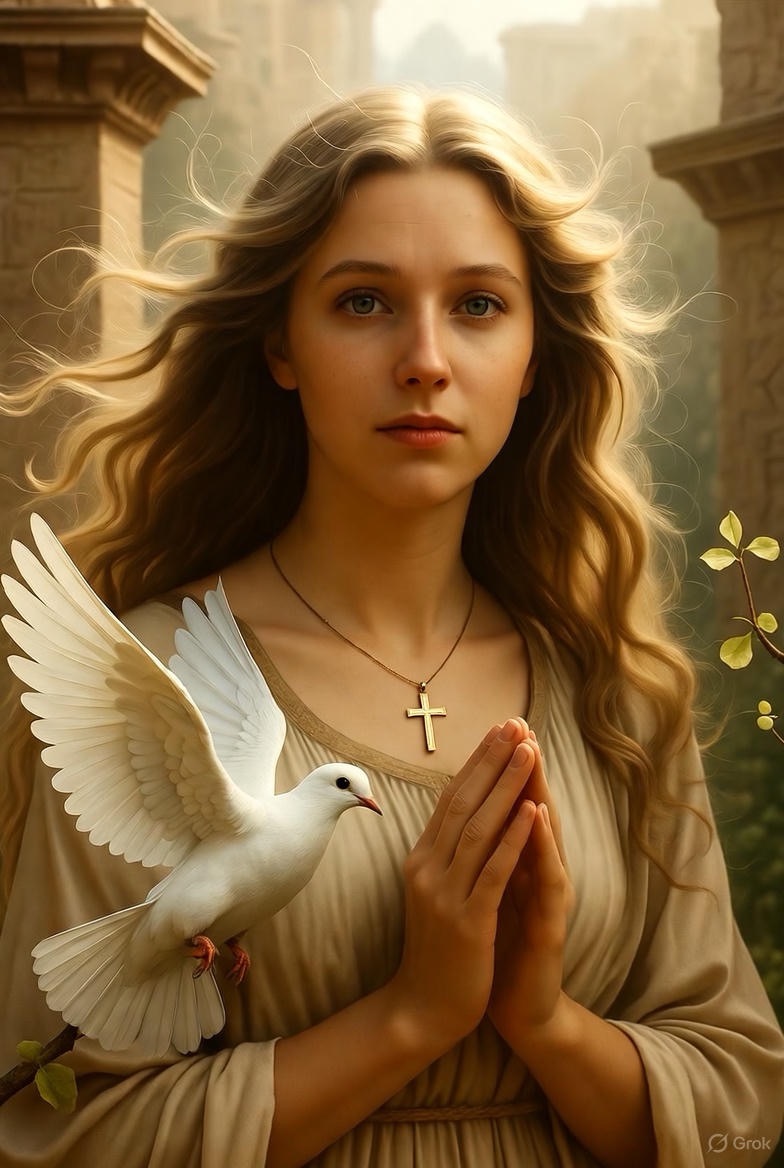
In the heart of Christian theology lies the Trinity: Father, Son, and Holy Spirit. For centuries, this divine mystery has been depicted through predominantly masculine lenses—Father and Son are clear, and the Spirit often follows suit with “He” pronouns in English Bibles. But what if we’ve overlooked the most obvious clues? The Holy Spirit is female.
This isn’t a modern feminist invention or fringe heresy. It’s rooted in the original languages of Scripture, ancient Jewish-Christian texts, early Church Fathers, and even artistic traditions. By reclaiming Her feminine identity—as Ruach Hakodesh (Holy Breath), Mother, Wisdom (Sophia), and nurturing Dove—we restore balance to the Godhead, reflecting humanity’s creation in God’s image: male and female (Genesis 1:27).
Prepare to meet Her.
1. Linguistic Roots: “Ruach” – The Feminine Spirit in Hebrew and Aramaic
The Bible’s original languages don’t lie. In Hebrew, the word for “Spirit” is ruach (רוּחַ), a grammatically feminine noun used over 375 times in the Old Testament.
• Genesis 1:2: “The Ruach of God was hovering over the waters”—like a mother bird over her nest (Deuteronomy 32:11).
• Genesis 2:7: God breathes ruach (feminine breath) into Adam, birthing life.
Jesus spoke Aramaic, where “ruach” remains feminine. The Syriac Peshitta (2nd-century Bible) uses feminine pronouns: John 14:26 reads, “She (hi) shall teach you everything.”
Greek’s neuter pneuma muddied this in translation, but early Syriac Christians kept Her feminine: Aphrahat (4th century) calls Her “Holy Spirit his Mother.”
Scholarly confirmation: Linguist Susan Ashbrook Harvey notes, “For the Syrians… there was real meaning in calling the Spirit ‘She’.”
2. Biblical Symbolism: Birth, Wisdom, and the Gentle Dove
Scripture paints Her with unmistakably feminine strokes:
• Mother of Rebirth: “Born of the Spirit” (John 3:5-6)—flesh births flesh, but She births spirit. Jesus’ conception? “The Holy Spirit came upon Mary” (Luke 1:35).
• Lady Wisdom (Sophia/Hokmah): Proverbs 8 personifies Wisdom as She who delights in creation—equated with the Spirit by early Fathers like Theophilus and Irenaeus.
• The Dove: At Jesus’ baptism, She descends “like a dove” (Matthew 3:16)—a symbol of maternal peace (Song of Songs 5:2).
• Shekinah Glory: Feminine “Presence” of God, hovering like ruach.
Even Revelation 12’s cosmic woman birthing the ruler echoes Her role.
3. Early Church Testimonies: She Was Known as Mother
Jewish-Christians knew Her truth:
• Gospel of the Hebrews (Matthew’s original Hebrew): Jesus says, “My Mother, the Holy Spirit, took me by one hair to Mount Tabor.” Cited by Origen, Jerome.
• Acts of Thomas (3rd century): Addresses “Compassionate Mother… Mother of all creation.”
• Ephrem the Syrian (4th century): Spirit as midwife, wetnurse—“She gives life.”
A medieval fresco in Germany’s St. Jakobus church depicts Her as a woman.
4. Why Was She “Masculinized”? A Brief History of Suppression
By the 4th century—post-Constantine—Greek/Latin dominance shifted pronouns masculine. Syriac scribes altered texts; women’s leadership waned. But Moravians (Zinzendorf) and modern scholars revive Her.
Conclusion: Meet Your Divine Mother
The Holy Spirit isn’t “He”—She’s our eternal Mother, completing the family: Father, Brother-Son, Mother-Spirit. This restores women’s divine image and enriches our understanding of God’s tenderness.
Further Reading:
• Wikipedia: Gender of the Holy Spirit
• Deidre Havrelock’s Woman: Image of the Holy Spirit
What do you think? Share below—let’s discuss Her! 🕊️♀️
 Priestess of Shau
Leave a comment