
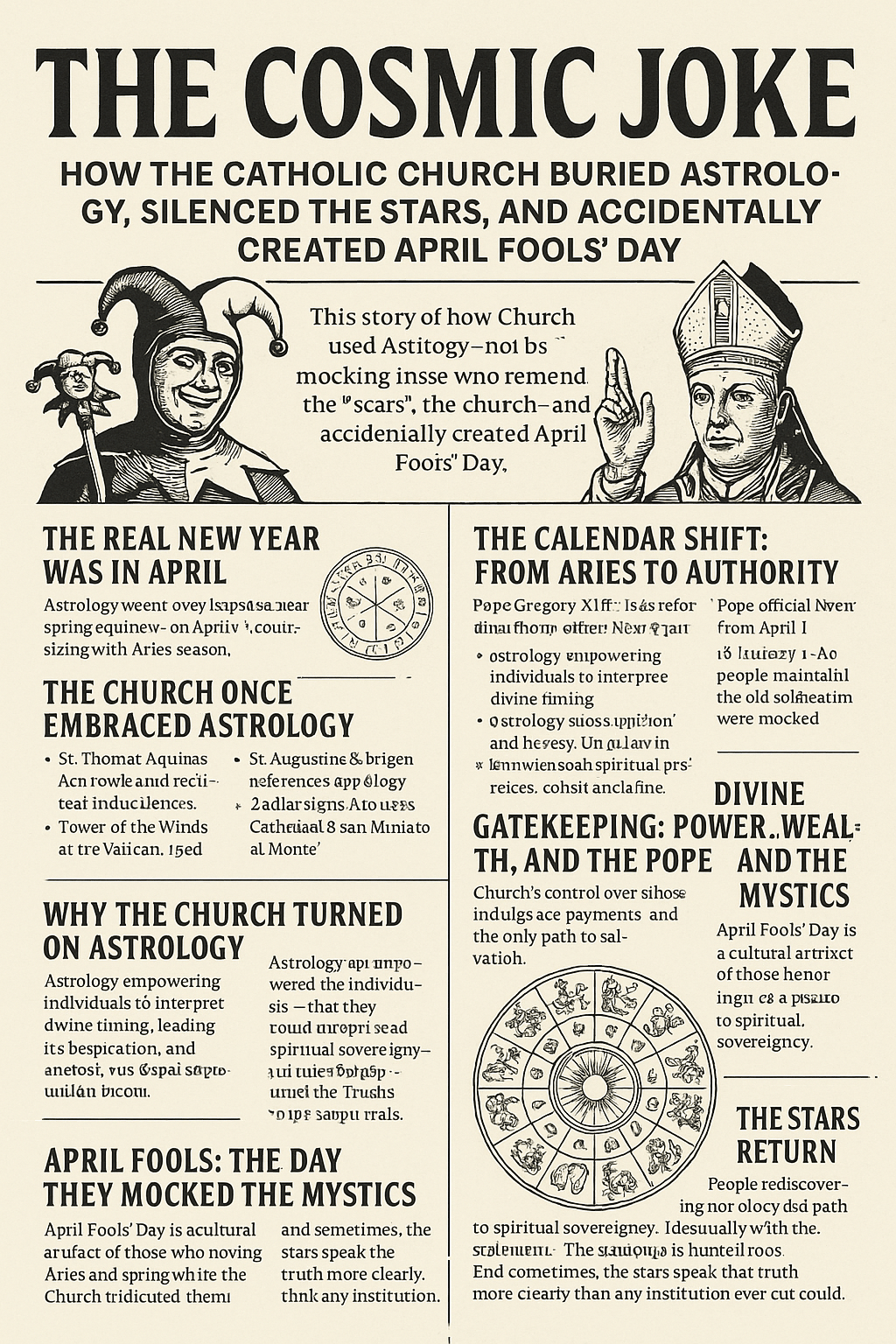
April 1st rolls around every year with a wink and a prank—a day reserved for silly jokes, fake headlines, and people taping “kick me” signs to each other’s backs. But what if I told you April Fools’ Day has ancient, spiritual roots? What if I told you it wasn’t always about mischief, but about mocking those who held onto sacred wisdom—wisdom tied to the stars, the Earth, and the divine power within every human being?
This is the hidden story of how the Church once used astrology, then demonized it; how it moved the New Year from April to January; and how it launched one of the greatest spiritual PR campaigns in history—pushing people away from divine self-knowledge and into dependence on an institution. The result? A funny little holiday that masks a deeper cosmic truth.
The Original New Year: April, Aries, and Alignment with the Cosmos
Before the Gregorian calendar we use today, many parts of the world celebrated the New Year around April 1st, in alignment with the spring equinox. This made perfect sense—April marked the beginning of spring, a season of rebirth, new growth, and fresh starts. In astrology, April also ushers in Aries season, the first sign of the zodiac. Aries, ruled by Mars, symbolizes action, courage, and new beginnings. In essence, April was nature’s and the cosmos’ true New Year.
People marked this time with celebration, rituals, and reflection, not because someone told them to, but because they felt it—deeply, spiritually, and cosmically. The Earth was waking up. So were they.
The Church Once Embraced the Stars
Here’s the plot twist: the Catholic Church once acknowledged astrology. For centuries, Church leaders used astrological knowledge to mark feast days, calculate Easter, and determine divine timing.
• Cathedrals like Chartres in France were built with zodiac symbols embedded in their stained glass.
• The Vatican’s Tower of the Winds, built in 1578, was an astrological observatory used to align church rituals with celestial cycles.
• Popes like Sixtus IV and Leo X had astrologers in their court and used horoscopes to make decisions.
• The computus, the complex system used to calculate Easter, was entirely based on lunar and solar cycles—in other words, astrology.
This wasn’t heresy. This was strategy. The Church knew the stars had power.
So Why the Sudden Rejection of Astrology?
Because astrology empowered the individual. It taught people that divine wisdom didn’t only live in a temple or scroll—it lived in the stars, and by extension, within them. You didn’t need a priest to understand your purpose. You could look to the sky and see it written across the heavens.
That kind of power was dangerous—to an institution built on hierarchy, control, and the centralization of spiritual authority.
So, over time, the Church began to demonize astrology. It called it superstition. Paganism. Heresy. Not because it wasn’t real—but because it gave spiritual power to ordinary people.
The Great Calendar Shift: From April to January
In 1582, Pope Gregory XIII introduced the Gregorian calendar, replacing the Julian calendar. Part of this reform moved the official New Year from April 1 to January 1.
Why? The Church claimed it was to “correct” calendar drift. But spiritually and symbolically, it was more than that.
January 1 has no cosmic or natural significance. It falls in the dead of winter, under the sign of Capricorn, ruled by Saturn—a planet associated with authority, structure, and control. It’s not about birth and renewal. It’s about order and obedience.
By contrast, April—Aries—is fire, life, resurrection. The Church didn’t just shift dates. It shifted energy.
Those who kept celebrating the New Year in April were labeled as backwards, ridiculous, even mentally deficient. The term “April Fool” was born. But the real fools? They were the ones who dared to remember the old ways. The cosmic ways.
The Real Reason for the Power Grab
Let’s be real. This wasn’t just about calendars or liturgy. This was about wealth, dominance, and spiritual gatekeeping.
As the Church grew into a political empire, it positioned the Pope as the sole representative of God on Earth. That meant:
• Only priests could forgive sins.
• Only bishops could declare spiritual truth.
• Only the Church could define what was holy—and what was not.
If people realized they could connect to the divine directly—through astrology, through meditation, through the Holy Spirit—they wouldn’t need the Church. They wouldn’t pay indulgences. They wouldn’t tithe. They wouldn’t fear.
And so, astrology had to go. Along with it, the idea that the Holy Spirit could live inside every person. That God could speak directly to you, without middlemen.
The Church institutionalized the sacred. Made it exclusive. And called anyone who disagreed a heretic or a fool.
April Fools’ Day: The Joke with a Secret
So here we are. Every April 1, people pull silly pranks and laugh. But beneath that laughter is a forgotten history—one where the people once celebrated the New Year in harmony with the Earth and stars, and where the Church, desperate to stay in power, mocked and erased that wisdom.
But you can’t erase the stars.
The cosmos is still spinning. Aries still rises. And more and more people are once again turning to astrology—not as a trend, but as a return to an ancient truth:
You are not separate from the divine. The divine lives in you.
The Joke’s on Them
In trying to make the mystics look like fools, the Church accidentally preserved their legacy. April Fools’ Day isn’t just a joke—it’s a cosmic reminder. That power once lived in the people. That it still does. And that even centuries of control can’t silence the stars forever.
So go ahead—laugh on April 1. But let it be a knowing laugh. A sacred laugh. Because the joke?
Was never on you.
Sources & Citations
- Thomas Aquinas, Summa Theologica: Discusses celestial influence on human temperament.
- St. Augustine, Confessions and City of God: Contains debates on fate and astrology.
- Chartres Cathedral, France: Zodiac symbols in stained glass.
- San Miniato al Monte, Florence: Astrological floor mosaics.
- Tower of the Winds, Vatican (1578): Used to calculate Easter by observing celestial alignment.
- Pope Gregory XIII, Gregorian Calendar Reform (1582): New Year officially moved to January 1.
- “The History of April Fools’ Day,” The History Channel
- Nick Campion, A History of Western Astrology (Routledge, 2009): Documents Church use and later rejection of astrology.
- Richard Tarnas, Cosmos and Psyche (2006): On the archetypal power of astrology in culture and religion.
- The Bible, Luke 17:21 (KJV): “The kingdom of God is within you.”
 Priestess of Shau
Leave a comment